Building date: Completed 1850
Original use:
Corner structures:
Mortar application and content:
Types and uses of stones:
Types and choice of windows:
Structures with similar masonry details:
Masons who worked on building: Edwin F. Reeves
Unique features:
Map views courtesy Google Maps. Address is Google Earth confirmed; 42°02'03.26"N 88°16'39.24"W. Current owner of record, Cumins Holdings LLC, Andrew Cuming as of the 2019 Tax Roll.
Township of Elgin and Kane County Maps.
The Gifford-Davidson House, also known as "Stone Cottage," at 363-365 Prairie St., Elgin, Illinois, was built by James Gifford in 1850. However, if so, it's clearly a retrofit of the Second Empire style popular in the 1860s through 1880s. It was placed on the National Register in 1980. The house was designed by Edwin F. Reeves, a native of New York. It is within the Elgin Historic District. Gifford was a native of central New York and was one of the founders of Dundee, Yates County, N.Y. He moved west to Kane County, Ill. in 1835 and was one of the founders of the town of Elgin, Ill. He was a prominent businessman, built roads and furnished wood used to fuel steamboats. Richard Palmer blog.
363-365 PRAIRIE STREET, Gifford House-1849-50 and 1871
This curious combination of two different architectural styles was begun in 1849 when James T. Gifford, who had come to the area from up-state New York, set the mason Edwin F. Reeves, who knew up-state New York cobblestone construction techniques, to work. The next year Gifford, who had founded Elgin in 1835, moved into the house, which long remained one of the town's showcases. Surrounded by a cast iron fence that kept a herd of deer within landscaped grounds that ran from Chapel to Gifford streets and from Villa to Prairie streets, "The Stone Cottage," as it was called, was the scene of many festive gatherings, but these were presided over by his eldest daughter and her husband, Orlando Davidson, because Gifford had died soon after moving into the house, in 1850.
In 1871 Davidson, by now proprietor of Elgin's Home Bank, rebuilt the house in the latest style. He added a wing and, more importantly, a Mansard roof with a balustrade above the cornice which was supported by evenly spaced modillions and with large, round-headed dormers and, finally, cast iron crestings along the top curb. The result was somewhat curious. Mansard roofs should go above a second story, and the two stories below should be massive enough to carry the visual load. Here, it sits atop the first story which is made of highly textured, multicolored, small-scaled cobblestones, and it seems to press those walls into the ground. By 1871 there were not
enough cobblestones available to extend the walls, or perhaps the founder's daughter had an attachment to the old house and this represents a compromise between her and her husband.
After Davidson died in 1899 the building was chopped up into apartments, the original front entrance (which faced west) replaced by a new one facing north, the outbuildings with their stables and servants' quarters removed, and the grounds subdivided into individual lots. What survives today is an excellent example of cobblestone construction with dressed stone for quoins and lintels, and with the columns Gifford wanted along the verandas because they reminded him of homes he had seen in South Carolina. Atop the "Stone Cottage" rests the stylish Mansard roof his son-in-law built, with its balustrade and cresting lost but with its pompous presence still quite evident. The building is listed on the National Register of Historic Places. Courtesy "A Guide to Chicago's Historic Suburbs" On Wheels & On Foot, by Ira J. Bach, assisted by Susan Wolfson, Swallow Press, 1981, pages 256-257.
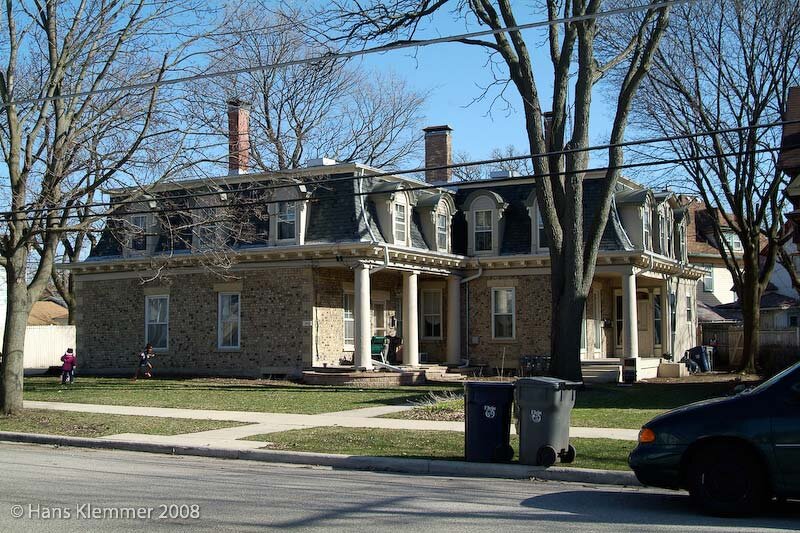 | Current photographs with audio and text description of historic and architectural significance, courtesy Historic Elgin website. There is a gallery of four photographs of the structure on this webpage. Photography courtesy Historic Elgin.com. |
|
 National Register of Historic Places Registration
- "Cobblestone Masonry", 1966, Carl Schmidt: Name reference, Gifford - Troxel House
- Pages 209 - 210, Page 323
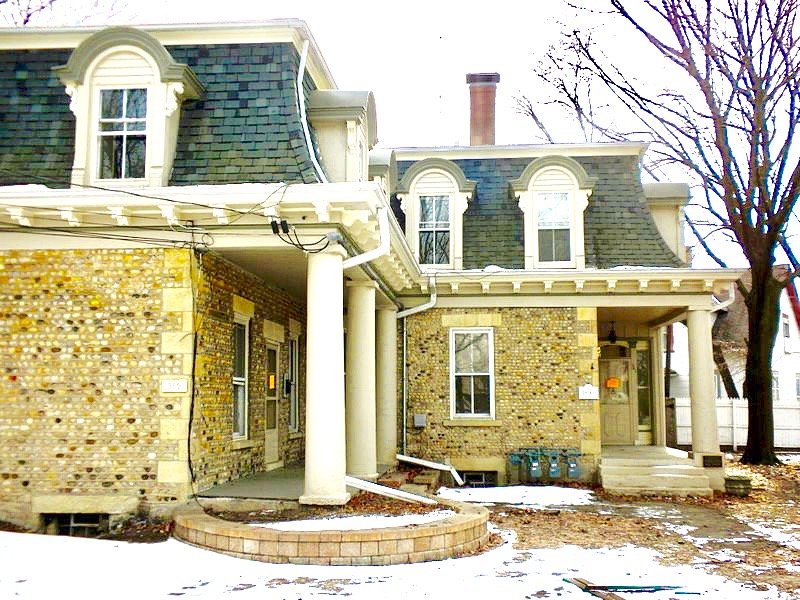 Elg-1 Gifford-Davidson House.jpg ¹ |
|
¹ Image courtesy Richard Palmer blog. Attribution not provided.
